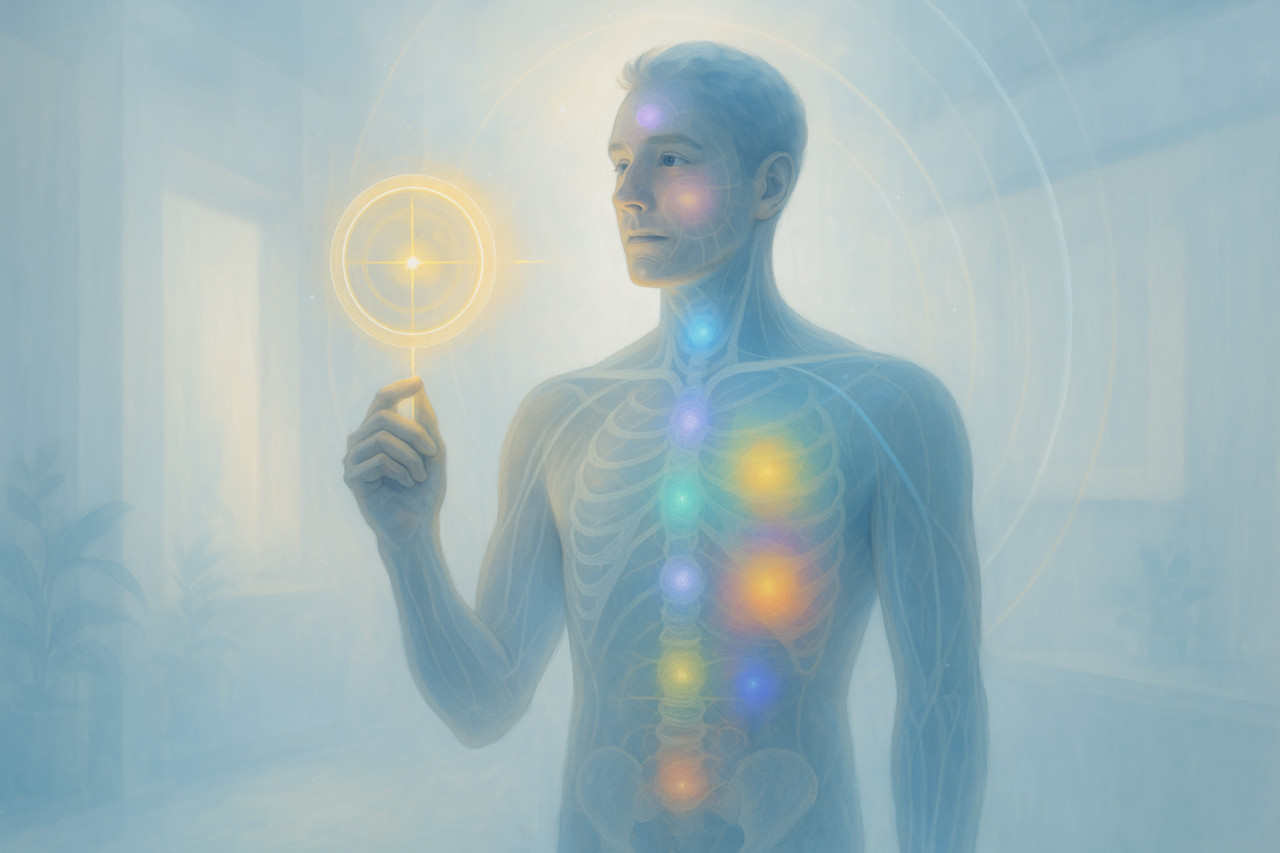
For centuries, healers across traditions have observed that the body “remembers” far more than we consciously realize. Kinesiology is one of the few modern healing modalities that gives us a method to communicate directly with the body’s wisdom — not through words or diagnosis, but through subtle muscular feedback and somatic awareness.
In the BodyLens system, kinesiology is used as a gentle, intuitive tool to access unconscious stress, energetic blockages, and emotional resistance that might be stored in the body — particularly in relation to chronic physical symptoms. Whether someone is deeply embodied or feels disconnected from their body due to trauma, ADHD, or neurodivergence, this approach can offer an empowering way to explore inner alignment and release.
But before we dive into how we use kinesiology in BodyLens, let’s first understand what kinesiology is — and what it’s not.
🧠 What Is Kinesiology?
Kinesiology is a therapeutic approach that studies the body’s movement and response, especially in relation to stress, belief, and health. It emerged in the 1960s from the work of Dr. George Goodheart, a chiropractor who noticed that specific muscles would weaken or respond differently when his patients were under stress — physically, emotionally, or energetically.
This observation led to the development of Applied Kinesiology, which has since inspired multiple offshoots, each with its own lens and focus. Despite their differences, all forms of kinesiology share a common belief:
The body can tell us — through muscle testing and stress response — what it finds supportive, safe, or out of alignment.
Rather than relying on conscious thought, kinesiology listens to the nervous system directly. In this way, it bypasses logic and taps into the subconscious, making it especially useful for surfacing emotional root causes or long-held energetic patterns.
🔍 Key Types of Kinesiology and Their Differences
There are many branches of kinesiology today, but a few stand out in terms of popularity and therapeutic depth. Here’s a breakdown of the most relevant forms — and how they differ from one another:
1. Applied Kinesiology (AK)
- Origin: Founded by Dr. George Goodheart
- Core method: Muscle testing to diagnose physical imbalances (e.g., organ stress, nutritional deficiencies, spinal misalignment)
- Practitioner-led: Requires formal training; not designed for self-testing
- Often used in: Chiropractic settings, functional medicine
Applied Kinesiology is highly structured and diagnostic in nature. It’s a clinical tool used to evaluate body function and recommend treatment strategies. However, it’s not easily adapted for home use.
2. Touch for Health (TFH)
- Origin: Created by Dr. John Thie to make AK more accessible
- Core method: Uses muscle testing combined with acupressure points and energy balancing
- Focus: Preventative care, stress relief, and energy flow
- Designed for: Both professionals and self-care
Touch for Health integrates Eastern meridian theory and offers simple protocols for identifying energy imbalances in the body. It’s often used in workshops and is highly suited for personal growth.
3. Emotional / Intuitive Kinesiology
- Emergent style: Found in many healing modalities and intuitive coaching
- Core method: Muscle testing combined with emotion-based statements or affirmations
- Focus: Identifying emotional stress or subconscious resistance
- Ideal for: Energetic healing, trauma release, self-awareness
This approach is less diagnostic and more interpretive. It allows the practitioner (or individual) to test statements such as “I feel safe speaking my truth” and observe the body’s response. It works especially well for inner child healing, belief repatterning, and trauma-informed embodiment.
🌈 The BodyLens Approach: Gentle, Intuitive Kinesiology
In Self-Tunify’s BodyLens module, we draw inspiration primarily from intuitive kinesiology and Touch for Health. Our goal isn’t to “fix” or diagnose, but to help the user feel where stress lives in the body — and to release it through gentle rituals, affirmations, or movement.
We’ve simplified the process so that anyone — including complete beginners and those with sensory processing challenges — can use it meaningfully.
Here’s how we tailor kinesiology for your healing experience:
✅ Self-led Exploration
You don’t need a practitioner. You’ll be guided step-by-step through how to test your own body’s response using finger strength, posture, or somatic awareness cues.
✅ Statement Testing
We offer emotionally resonant phrases relevant to your condition — for example:
“I have to carry everything myself.”
“I don’t deserve rest.”
“I’m not allowed to let go.”
You say them aloud, and observe what happens in your body: a subtle weakness, tension, clenching, or a change in breath. These cues reveal where resistance lives.
✅ Embodied Integration
Once a “stressed” belief is identified, we guide you through release. This may include breathwork, hand placement, mirror rituals, or a shift in posture — often paired with affirmations that allow safety, voice, and permission to emerge.
⚠️ What If You Don’t Feel Anything?
That’s okay. Many people — especially those who are neurodivergent, emotionally exhausted, or disconnected from the body due to trauma — struggle to “feel” subtle shifts.
In BodyLens kinesiology, sensitivity is not required.
Instead of forcing clarity, we encourage a playful, curious, and observational approach. We trust that even small shifts (a pause, a sigh, a flutter of emotion) are meaningful — and that repetition over time deepens awareness.
This practice isn’t about perfection. It’s about permission — to be where you are and gently explore from there.
For a detailed explanation on this topic, read our dedicated post.
💬 A Final Thought
Your body has been speaking all along — often in whispers, sometimes in discomfort, always in truth.
Kinesiology gives you a way to listen, even when language fails. It helps you tune into what your body has held quietly, sometimes for years. And through that process, healing becomes not a task, but a collaboration.
In the BodyLens system, we use kinesiology not as a tool of control — but as a gateway to reverent embodiment, emotional honesty, and energetic sovereignty.
Let the body lead. It knows the way home.