


🔍 The Hidden Filter That Shapes Your Reality
Most people go through life believing they are experiencing reality exactly as it is — objective, unfiltered, and neutral. But this is far from the truth. What you perceive in any given moment is not the whole picture. It is a curated slice of existence, selected for you by a part of your brain called the Reticular Activating System, or RAS. This system is constantly working behind the scenes, determining what gets your attention and what fades into the background. Understanding how it functions, and more importantly, how it can be retrained, gives you a profound key to reshaping your life from the inside out.
🔬 What Is the RAS and How Does It Work?
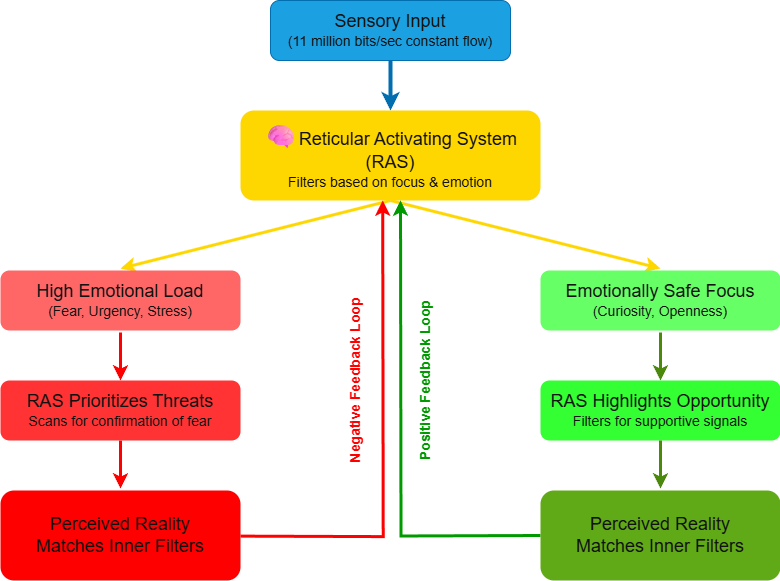
The Reticular Activating System is a network of neurons located in the brainstem. Its main role is to regulate levels of consciousness, wakefulness, and — most crucially for our purposes — selective attention. Every second, your senses are bombarded with more than 11 million bits of information. Yet your conscious mind can only process a fraction of that — around 50 to 100 bits. So how does your brain choose what to let in?
This is the job of the RAS. It acts like a filter or gatekeeper, allowing in only the sensory data that it deems important based on what you consistently focus on, think about, believe, and feel. In other words, you are not seeing reality itself — you are seeing the version of reality that your RAS believes is most relevant to you.
This relevance isn’t based on logic or truth. It’s based on repetition and emotional intensity. What you think about frequently and what you attach strong emotion to are the two main criteria that tell your RAS, “This matters — let more of this in.”
🧲 Why Emotional Weight Changes the Outcome
Here’s where things get more nuanced — and more powerful. While the RAS responds to both thoughts and emotions, the emotional load you associate with a thought dramatically affects how the RAS prioritizes it. The more emotionally charged something is — especially with fear, urgency, or threat — the more intensely your brain will scan your environment for confirmation of that perception.
This explains a phenomenon that confuses many people. You might say something neutral like, “I rarely see white cars,” and then suddenly start seeing white cars everywhere. But when you say, “Fewer and fewer clients are booking,” you don’t see clients showing up — you see even more evidence of lack. What’s the difference?
It’s not just the words you speak. It’s the emotional energy underneath them. When you mention white cars, you’re likely calm, neutral, even curious. There’s no stress attached. Your RAS hears “white cars,” tags it as a new point of interest, and begins highlighting them in your environment. No resistance. No survival urgency. Just a new target.
But when you focus on “fewer clients,” the emotional signature is completely different. That statement is often soaked in fear, stress, self-doubt, and anxiety about the future. You may not consciously realize it, but your subconscious registers this as a threat. And when your brain believes a threat is present, it prioritizes confirming that threat. Your RAS begins scanning not for solutions — but for proof that the fear is valid. That’s the evolutionary design: survive first, understand later.
This is why fears and limiting beliefs are so sticky. Once emotionally validated, your RAS starts filtering the world in a way that supports the exact reality you don’t want — not out of malice, but out of loyalty to your nervous system’s perceived need to protect you.
🔁 The Loop Between Focus, Fear, and Filtering
Let’s break this down even further. The RAS forms a feedback loop with your emotions and beliefs. You think a thought, like “I’m not getting enough clients.” That thought is charged with emotional weight — fear of losing income, fear of being seen as a failure, or even deeper survival fears around not being supported. That emotional intensity flags the thought as “important” to your RAS.
Now the RAS starts filtering the environment to match it. It becomes more attuned to things like an empty calendar, late payments, unsubscribes, or moments of silence on social media. It tunes out or downplays positive signals, like someone who said they’d recommend you, or a kind comment you received. The brain, believing it is protecting you, begins to build a story around your focus. You then see more proof of what you fear, which reinforces the belief, which keeps the RAS locked into that filtering mode.
This is why people often feel stuck in a pattern even when they try to “stay positive.” If the emotional reality doesn’t change, the RAS doesn’t shift — no matter how many affirmations you say. You can’t override fear with empty words. But you can start to shift what the RAS prioritizes by changing how emotionally safe and congruent your focus feels.
🛠️ How to Reprogram Your RAS to See a Different Reality
If you want to change your life, you don’t need to manipulate the outside world. You need to train your perception to align with a different truth — one that your nervous system can believe, and your RAS can follow. Here’s how to do it in practice:
1. Name the Emotional Load Behind Your Focus
Before trying to shift your focus, pause and ask yourself:
What emotion is fueling this thought right now?
Is it fear? Desperation? Shame?
Or is it curiosity, desire, openness?
The Reticular Activating System (RAS) does not distinguish between helpful and harmful focus. It simply amplifies what your nervous system labels as important — and emotional charge is the main criteria. When your focus is driven by survival-based emotion (like fear or lack), your RAS prioritizes filtering for threat, problems, and “what’s wrong.” But if your focus is grounded in emotionally safe states — like calm anticipation, wonder, or authentic desire — it begins to filter for possibility, synchronicity, and hidden support.
The goal is not to suppress difficult emotions or fake positivity.
It’s to bring awareness to the emotional engine behind your attention, and to consciously shift toward a more regulated emotional baseline. That shift alone can be enough to redirect the filter.
So before you repeat affirmations, visualize your goals, or ask better questions — start here.
Name the emotion. Normalize it. Then choose if it’s safe to shift.
Because until your inner world feels safe, the RAS will keep scanning for threats — no matter how beautiful your intention.
2. Use Emotionally Believable Language
Instead of repeating exaggerated affirmations that your subconscious rejects, use gradual, emotionally aligned statements that feel possible — not forced. These kinds of affirmations gently open the RAS to notice new forms of support, evidence, and alignment without triggering resistance.
Examples:
- “I’m starting to notice where opportunities might be hiding.”
- “There may be more support around me than I’ve realized.”
- “It’s okay if I don’t know everything yet — I can grow at my own pace.”
- “I’m open to trying new approaches, even if I’m not sure they’ll work yet.”
- “Each day is a new chance to move a little closer to what I want — even through small steps.”
- “Mistakes are a natural part of learning. They don’t define my worth.”
- “I trust that my efforts will eventually bear fruit — even if I don’t see results right away.”
- “It’s safe to ask for help when I need it. That’s not weakness — that’s self-awareness.”
These affirmations meet your nervous system where it is — not where your ego wishes it were — which allows your subconscious to receive and integrate them as a new baseline for perception.
3. Visualize With Feeling, Not Just Imagery
The brain does not respond most powerfully to abstract mental pictures — it responds to emotionally charged inner experiences. Neuroscience shows that when we vividly imagine an event while simultaneously feeling it as real, the brain lights up in much the same way as it would if the event were actually happening. This is where visualization becomes transformational — not as daydreaming, but as an emotional rehearsal of a future truth.
So when you visualize, don’t just “see” a client booking a session or a payment notification arriving. Let your nervous system feel it.
Feel the satisfaction.
Feel the sense of alignment.
Feel the gratitude as if it’s already part of your timeline.
Let the imagined success move through your chest, your breath, your posture.
This is what recalibrates the Reticular Activating System. The RAS doesn’t understand fantasy versus reality — it understands emotional priority. When you make a desired experience feel familiar, the RAS begins searching the environment for ways to match it. It shifts your filter toward noticing aligned cues, opportunities, and invitations you would have previously dismissed or ignored.
And the more often you rehearse that future version of yourself — with embodied feeling — the more naturally your internal filter begins to believe, “This is what we expect. This is who we are becoming.”
Emotion is the anchor. Visualization is the map.
Together, they train your brain to make the imagined… inevitable.
4. Ask RAS-Friendly Questions
Your brain loves solving puzzles. Instead of pushing yourself to believe something you’re not ready for, ask open-ended, emotionally safe questions that activate your RAS to scan reality differently. These questions shift your perception without resistance.
Examples:
- “What’s already working that I haven’t noticed?”
- “Where am I already being supported?”
- “What might success feel like if I stopped trying to force it?”
But let’s go deeper. Here are life-aligned categories and powerful RAS-activating questions for different situations:
💼 If you’re facing business, career, or financial challenges:
- “Who already values what I offer, even if they haven’t paid for it yet?”
- “What opportunities are already around me — as potential clients, partners, or inspiration — that I haven’t recognized?”
- “What strengths or skills do I take for granted that others might find valuable?”
💬 If you’re struggling with self-doubt or inner criticism:
- “What feedback have I already received that shows I matter to others?”
- “What do I do consistently well, but rarely give myself credit for?”
- “In which moments do I feel most natural, authentic, and self-expressed?”
❤️ If you feel stuck in relational patterns:
- “Where is love or care already being expressed in my life, even if not verbally?”
- “What patterns in my relationships have become healthier, even in small ways?”
- “How could I let in more support and intimacy without abandoning my boundaries?”
🎨 If you’re creatively blocked or spiritually disconnected:
- “What forms of expression are already flowing through me that I haven’t labeled as creative?”
- “Where does self-expression feel effortless — and how can I follow that?”
- “What ideas or visions have been quietly waiting for my attention?”
🌀 If you’re feeling lost, fatigued, or stuck:
- “What’s the next smallest step that feels light, not heavy?”
- “What message might life be sending me that I’ve been too busy or scared to hear?”
- “What possibilities have I dismissed simply because of an old belief?”
These are not questions to solve. They are questions to live with. When your RAS hears these gentle, curiosity-driven prompts, it begins filtering your environment in new ways. It picks up on signals that match these questions — sometimes subtly, sometimes dramatically — and before you know it, you’re seeing what was always there, but hidden by an outdated filter.
🌍 Final Insight: You’re Not Seeing Life As It Is — You’re Seeing What You’ve Trained Your Brain to Find
The Reticular Activating System doesn’t care about your dreams, your goals, or your potential. It only cares about what you’ve told it matters — through repetition, belief, and emotional charge.
If you’ve been living in cycles of scarcity, rejection, or fear, it may not be because reality is against you. It may be because your RAS is doing its job — faithfully filtering the world to match what you believe to be true.
But here’s the good news:
That filter isn’t fixed.
It’s not destiny.
It’s programmable.
And when you shift what your nervous system feels safe to perceive, your RAS will begin serving a new version of you — one who sees opportunity, support, synchronicity, and possibility where none existed before.
This is not mindset work. This is perceptual evolution.
And once you master it, you stop reacting to life — and begin shaping it from the inside out.
Continue to read Part 2: How Shifting Questions Rewire Your Reality (2/2)

